Dim Rooms, Sharp Plaster: Handheld High-Res Inside the Stately Home
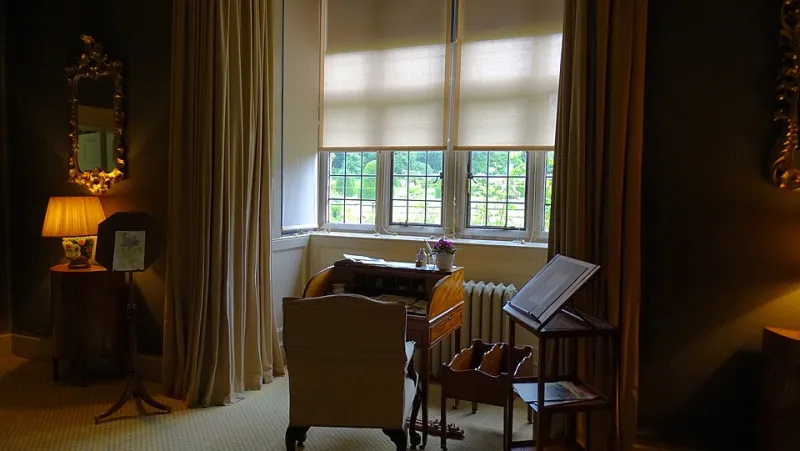
Photo: Paul Gover, CC BY 2.0, via Wikimedia Commons
The first thing you notice inside a National Trust house in December isn't the furniture. It's how little light there is. Curtains half-drawn, blinds down, a scattering of low-wattage bulbs doing their best, and a room steward watching you take your tripod out of the bag with the expression of someone who has seen this before and won't be seeing it today.
Fair enough. Tripods are banned in most houses for a cluster of sound reasons: conservation, insurance, footfall, and the fact that pressure-sensitive floor alarms don't much care how careful you are. But the ban no longer means giving up resolution. Handheld high-res changed that argument, and most people haven't caught up.
What handheld high-res actually does
In handheld high-res mode, the camera fires a rapid burst while the stabilisation system nudges the sensor around by sub-pixel increments. The frames are then merged in-camera, combining the slight differences in sampling position to produce a file of around 50 megapixels from a 20-megapixel sensor. You get more resolution, noticeably cleaner colour and far less noise in the shadows — which, in a room at forty lux, matters more than the pixel count.
Crucially, it's handheld. You can stand where the velvet rope lets you stand, tuck your elbows in, and capture detail a tripod couldn't have reached anyway because the tripod would have been at reception.
Light is the limiting factor, not technique
Here's the catch. The burst takes time. If your shutter speed is a tenth of a second, sixteen frames is well over a second of capture, and in that second a visitor walks through your long gallery and turns into a smear of anorak. The whole mode lives or dies on shutter speed.
So push the ISO. I'd rather have a 50-megapixel frame at ISO 3200 with a shutter speed of 1/60 sec than an exquisite ISO 200 frame with a ghost in it. Modern sensors and decent noise reduction handle the former comfortably; nothing rescues the latter. Set auto ISO with a ceiling of 6400 and a minimum shutter speed of 1/60 sec, and keep an eye on the histogram as you move from the hall (dark) to the window bay (bright).
Settings I use, room after room
- Mode: handheld high-res, JPEG plus RAW so you have a quick preview and a proper file.
- Aperture: f/4 to f/5.6. Wide glass at f/8 in this mode is asking for diffraction; the extra samples don't rescue a soft optical image.
- Exposure compensation: start at minus a third to minus two thirds to hold the windows. Blown sash windows are the classic stately-home failure.
- White balance: this is the colour problem of the whole day. LED retrofits, tungsten chandeliers and cold daylight through the glass all fight each other. Set a Kelvin value around 3200–3600K for the chandelier rooms, or custom-balance off a grey card and batch by room. Varnished portrait paintings go distinctly olive under cheap LEDs — worth a manual tweak afterwards.
- Level gauge and grid: on. Columns lean, and everything in these buildings is either perfectly symmetrical or deliberately not.
- Flash: off. Banned almost everywhere, hopeless against a forty-foot ceiling.
The movement problem, honestly
Handheld high-res will punish anything that moves. People, obviously. Also: firelight, curtains breathing in a draught, foliage outside a window, a chandelier on a long chain. Some of that can be composited away, some can't. Two habits help.
First, shoot the high-res frame and then immediately shoot a normal 20-megapixel frame of the same view. It's a safety net, and sometimes the smaller file is the better picture.
Second, arrive early. Houses tend to open quietly at eleven; the first hour is your window before the coach parties arrive, and stewards are usually far more relaxed about someone standing still for five minutes.
Blending for the window rooms
Long galleries and stairwells often have a five-stop gap between the floor and the sky outside. Three bracketed frames at one-stop intervals, merged later, will hold it all together. Alternatively, exploit the extra shadow latitude of the high-res file: the merge genuinely cleans up the dark areas, so a single frame plus a careful shadow lift can be enough. Reach for the highlight-and-shadow control in Workspace before you reach for a big HDR effect — most interiors look better slightly dark than aggressively even.
A room-by-room plan
Entrance hall and staircase. Look up. Plasterwork ceilings are the reason this mode exists — brace your back against a wall, tilt the screen, and let the stabiliser work. Watch for the verticals.
Long gallery. Symmetry, repeating frames, the shine on a polished floor. Wait for the room to empty, shoot both orientations, and use the level gauge rather than trusting your eye.
Drawing room. Portrait frames behind glass: step thirty to forty degrees off-axis to kill reflections, and decide whether the polariser's light cost is worth it. Here, it usually is.
Library. Book spines are a colour chart. Low light, deep shadows, and glorious texture. Ask before using a step stool.
Chapel. Stained glass is a metering exercise — expose for the glass and let the interior fall dark, or blend two frames.
Bedchamber. Textiles are the most light-sensitive things in the building. If a sign says no photography, that's the whole conversation.
Before you set off
Check winter opening hours — many houses run weekends only from November, and some close entirely in January for conservation cleaning. Membership of the National Trust, English Heritage or Historic Houses pays for itself quickly, and privately owned Historic Houses properties sometimes permit tripods by prior arrangement if you ask nicely in writing. Batteries drain fast in cold buildings and high-res mode is hungry; carry two spares. And when a steward offers you a story about the room, take it — it's usually the best caption you'll write all winter.