Rain on the Inside: A Window-Light Project for Olympus Street Shooters

Photo by Photo by Johen Redman on Unsplash on Unsplash
The window is the most underrated camera accessory in Britain. It gives you a seat, a frame, a rain filter and a legitimate reason to sit still for an hour while the light fails. From November onwards, that failure is the point. The early-dark season turns ordinary High Streets, station platforms and seafronts into low-lit stage sets. All you have to do is decide which side of the glass you are on.
The idea: one window, one hour
This is a project about looking out from private spaces into public ones. Café windows in Norwich or Lewes. Train carriages on the Settle–Carlisle line or the North Wales coast. A B&B room in Whitby, Llandudno or St Ives with a bay window and a view of wet rooftops. The rule is simple: shoot from the window, not through it as a novelty. Let the glass, the condensation and the interior reflections become part of the picture.
Choose a consistent hour. In December, that means roughly 3.30pm to 5pm, when the sky is blue-grey, shop lights are on and the streets are full of umbrellas. Work for ten sessions and you have a series. Work for twenty and you have a small book.
Why Olympus suits the shutter-dragging life
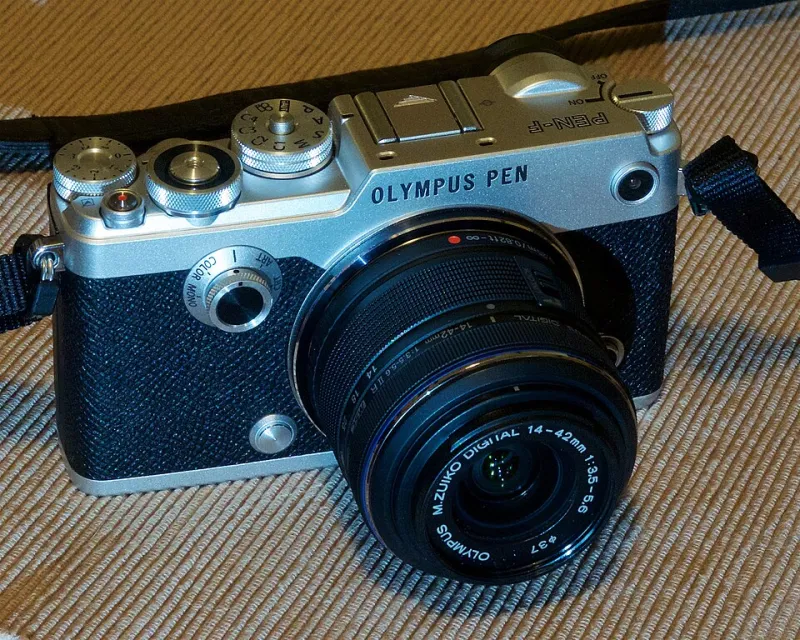
Low-light window work is mostly about handholding. The IBIS in OM-5 and OM-1 bodies lets you shoot at 1/10 sec or slower with a compact prime, which is often enough to blur a passing bus while keeping the window frame sharp. Pair a 17mm f1.8 or 25mm f1.8 with the body and you have a pocketable kit that does not look like a professional assignment. The 12-45mm f4 is slower but stabilised, and the extra width is useful in train carriages.
Silent shutter is the other quiet hero. In a café or a train, the electronic shutter removes the mechanical clack that makes everyone look up. Use it with care: some LED lighting can band, so check the frame and switch to mechanical if you see stripes. For the window itself, manual focus can be more reliable than autofocus. Focus on the glass and let the street go soft, or focus through a wiped patch and let the rain streak around it.
Live Composite is the special-weather tool. Rest the camera on a window sill or a table edge, set a base exposure for the static view, and let the camera add only the brighter moving lights. Traffic trails, pier illuminations, a bus pulling away from a stop: all become ribbons without blowing out the shopfronts. It needs a steady support, so save it for the B&B window or the café table where you can sit still. IBIS will not stabilise a multi-second composite on its own.
Rain-streaked glass is the collaborator
Do not clean the window. A small wipe with a cloth gives you one sharp area; the rest can stay veiled. Shoot at f2.8 or f4 to soften the streaks, or stop down to f5.6 if you want the street to read clearly through the water. Colour is the reward: tungsten interiors go amber, the blue hour goes slate, and a red bus or a neon sign becomes a single warm note in a cool frame.
Reflections are not mistakes. Let the interior of the café sit in the glass alongside the street. A hanging light, a row of bottles, the shape of a companion’s coat: these layers make the photograph feel like a window rather than a view. Turn off any flash. Turn off any filter that promises to remove reflections. You want the glass to have an opinion.
Etiquette: ask, do not assume
A café is private premises. Ask staff before you start, buy a drink, sit away from other customers and keep the camera low. Do not photograph staff or identifiable customers without consent. If someone notices and looks uncomfortable, stop. In a train carriage, photography is generally permitted, but it is still a shared space: avoid children, avoid anyone who is clearly distressed, and never use the window as an excuse to intrude. In a B&B, you have rented the room, not the view into the neighbours’ windows. Keep the lens inside your own space.
If you are asked what you are doing, have a simple answer. I am photographing the rain and the lights. It is a winter project. Most people are fine with that. The ones who are not deserve to be left alone.
Building a cohesive set
A series needs repetition. Pick one focal length for most of the frames, or one time of day, or one colour palette. Shoot the same kind of window in different towns: the station buffet, the seafront café, the B&B bay. Sequence the images so the viewer moves from interior to exterior, from rain to reflection, from warm to cold. Give each frame a plain title and the time it was made. The discipline of captioning forces you to notice what you are actually doing.
Edit for atmosphere rather than perfection. Keep the condensation, the smear, the odd elbow of a passing stranger. A clean street photograph is easy to find. A window photograph that feels like a British winter is harder.
A simple shot list for the next grey afternoon
Start with the window frame itself: verticals, sill, condensation. Then the street through a wiped patch. Then a reflection of the interior in the glass. Then a passing figure or bus at 1/10 sec. Then a Live Composite of traffic or pier lights if you have a steady ledge. Finish with the view from the train as it pulls out, the station lights smearing into the dark.
The project is not about technical showmanship. It is about permission: permission to sit in a warm room while the rain does the work, and permission to make the ordinary view out of a window feel like a body of work. Olympus kit makes that easy to carry and quiet to use. The rest is just choosing the seat.