Case Closed: Shooting Britain's Rainy-Day Museums Through Glass
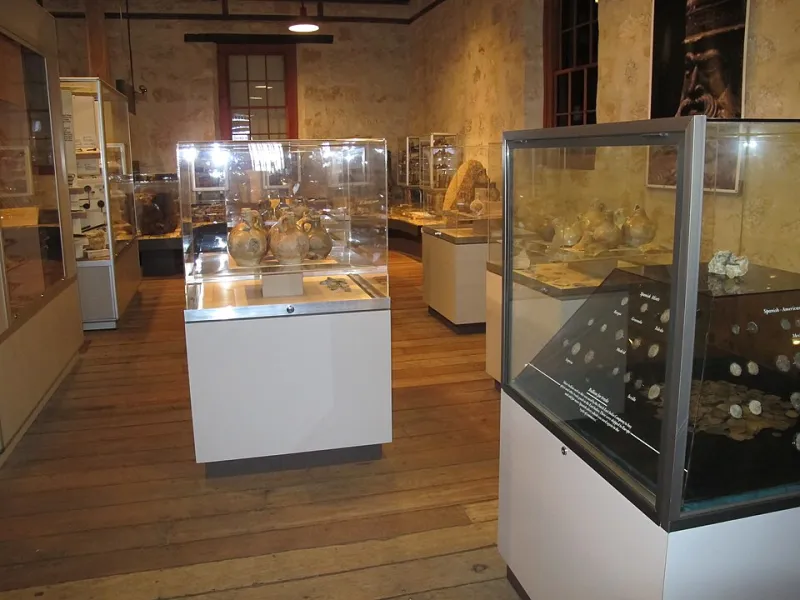
Photo: Marlene Oostryck (Wiki Takes Fremantle participant), CC BY 3.0, via Wikimedia Commons
There's a specific sort of British afternoon in late November. The sky is the colour of a boiled egg, the drizzle never quite commits to being rain, and the reservoir you drove forty minutes to photograph has turned into a study in beige. You could go home. Or you could park up, pay for an hour's parking, and spend the rest of the day photographing pocket watches in a room with terrible lighting.
This is the rainy-day genre nobody talks about: the museum macro shoot. It suits an Olympus kit down to the ground — small bodies, stabilisation that borders on witchcraft, and a lens ecosystem where a 60mm macro costs less than a decent pair of boots.
Why the display case is the best bad-weather subject
Museums are dim, glass-fronted, tripod-free and absolutely rammed with fine detail. That combination usually terrifies photographers. For a stabilised Micro Four Thirds body with a macro lens it's a gift. You get close, you work at moderate apertures where the lens is sharpest, and you let five or six stops of in-body stabilisation do the tripod's job — which is handy, because the tripod isn't allowed past the front desk anyway.
There's also a compositional bonus. A vitrine is a frame within a frame. Labels, hinges, the soft curve of a bell jar, the way a spotlight rakes across taxidermy fur: all of it is macro subject matter that doesn't care that the weather has collapsed.
Etiquette first, camera second
Almost every major UK museum bans flash in its permanent galleries, and the National Trust, English Heritage and most independent houses do the same. It isn't preciousness. Flash is genuinely damaging to works on paper and textiles, and it's useless through glass anyway — all you'll photograph is a white ghost of your own speedlight. Tripods and monopods are typically banned too, less for conservation than for footfall and insurance; a stool-height cluster of legs in a busy gallery is a trip hazard.
Ask anyway. Staff at smaller museums, university collections and local record offices are often delighted that someone wants to photograph the geology drawers properly, and quiet weekday mornings sometimes come with a discretionary permit. Always ask before photographing objects in a temporary exhibition — loans are often under tighter rights agreements than the permanent collection.
And please, don't lean over the barriers, don't rest your elbows on the case, and keep your bag in front of you.
Reflections: the rubber hood trick
The single most useful item in my museum bag is a collapsible rubber lens hood that cost about twelve pounds. Screw it onto the front of your macro lens, press the rim flat against the glass, and shoot straight through it. The hood seals the gap, blocks the room lights and kills your own reflection in one movement. A black fleece held at arm's length does a similar job if the case is bigger than your hood.
A polariser is the second tool. It'll cut glare off varnished ceramics, glazed tiles and oil paintings beautifully, at around thirty to forty degrees off-axis. Two cautions: it costs you a stop and a half of light you can ill afford in a gallery, and on some laminated or toughened display glass it produces odd rainbow stress patterns. Test one frame before committing. Polarisers also do little against reflections directly behind the glass surface, so the hood still does the heavy lifting.
Step slightly to one side of the case so your silhouette lands outside the frame, and watch for ceiling spotlights bouncing off the glass in the shape of a small bright ellipse. Usually you can shift six inches and make it disappear.
Settings that survive forty lux
Start with the electronic shutter. It's silent, it doesn't shake the camera, and in a hushed gallery it's simply good manners. Add anti-shock as a belt-and-braces measure.
- Stabilisation: on, always. With the 60mm Macro and a current body, a tenth of a second handheld is a realistic ceiling.
- Aperture: f/4 to f/5.6 for stacking sequences, f/8 only for flat subjects like labels or pressed flowers.
- ISO: don't be shy. 800 to 3200 is normal territory here, and modern noise reduction handles it with dignity.
- White balance: galleries are a horror of tungsten, retrofitted LED and daylight leaking through roof lights. Set a custom reading from a grey card, or shoot a reference frame of the same card in each room and batch it later in Workspace.
- Focus: manual, with magnification and peaking. Autofocus will hunt on low-contrast subjects behind glass, and the AF illuminator lamp is both annoying and reflective. Turn it off.
Stacking in a room full of people
Olympus gives you two flavours. Focus bracketing fires a sequence you merge later and gives you RAW flexibility; in-camera stacking composites fifteen frames into a single JPEG on most bodies, which is fast, shareable and slightly limiting. For a diorama forty centimetres deep, the 30mm Macro at f/4 with a step of three or four will do a lovely job; for flatter objects the 60mm is cleaner at the edges.
Handheld stacking absolutely works — brace your elbows on the barrier rail, breathe out, and let the camera rattle through the sequence. Look out for movement: water in model boats, waving foliage in a diorama, the flicker of an old film loop.
Where to point it
Pitt Rivers in Oxford is a cathedral of dusty, low-lit clutter. The Hunterian in Glasgow has the strangest objects in Britain in the worst light in Britain. The Bowes Museum's automaton, the pinned beetles at the Natural History Museum, the clockwork at Kelvingrove, the lace at Compton Verney. Old labels under glass are a genre of their own — typewriters, copperplate, brown card and all.
Grey afternoon, dry feet, sharp frames. There are worse ways to spend a Saturday.