The Early-Dark Season: Olympus Settings for Britain’s Four O’Clock Twilight
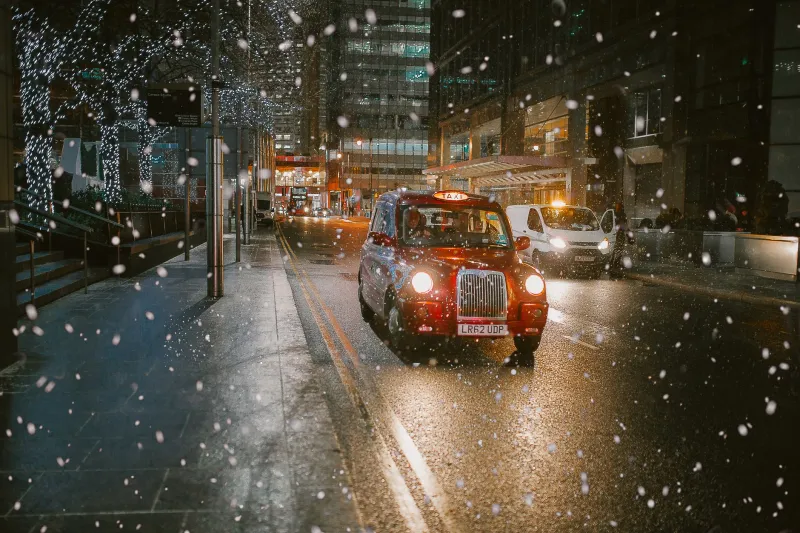
On 8 November 2026, sunset in London lands at about 16:20. By the time you have found a parking space, zipped your jacket and wiped the drizzle off the front element, the golden hour has already become blue hour. For a few weeks each year, Britain’s photographic day ends before the school run does. It is easy to treat that as a loss. I prefer to treat it as a season.
The early-dark season is not a write-off
The light after the clocks go back is not thin summer light with the volume turned down. It is its own thing: low, soft, often wet, and full of small sources — shop windows, bus headlights, Christmas switch-ons, the orange glow of a chip shop queue. The skies may be grey, but the streets are not. This is the time for reflections, pools of colour and slow exposures, not for packing the camera away until March.
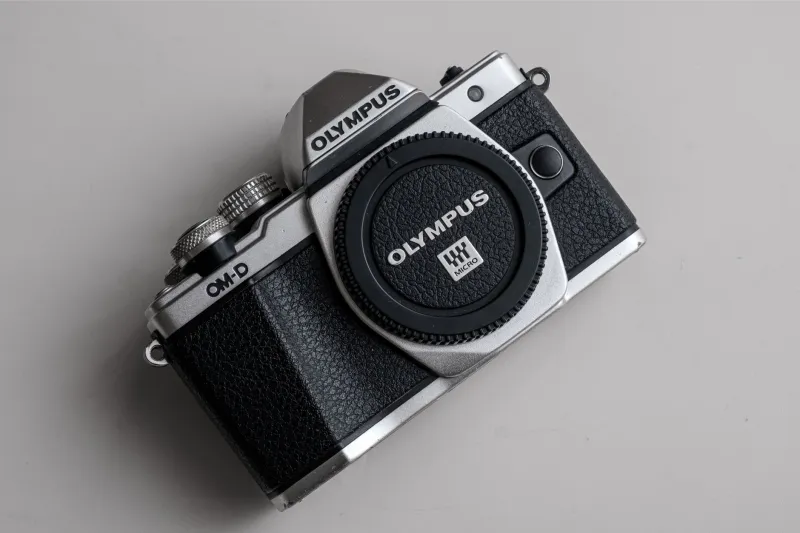
The practical problem is obvious. You are often shooting at the end of the working day, without a tripod, in a hurry, with cold hands. Olympus bodies are well suited to that reality. The stabilisation is excellent, the lenses are small enough to carry, and Live Composite turns a wet pavement into a light-trail studio. You do not need a major expedition. You need a pocketable kit and a few decisions made in advance.
Let stabilisation buy you stops
The first rule of early-dark handheld shooting is to stop treating 1/60 sec as a floor. With a modern Olympus body and a stabilised lens, a careful 1/10 sec is often perfectly usable, especially at wide angles. Brace your elbows against a wall, tuck your arms in, exhale, and take three frames rather than one. The second or third is usually the sharp one.
Use the normal 5-axis stabilisation mode for most handheld work. If you are using a Sync IS lens, let the lens and body work together and avoid fighting the system by stabbing at the shutter. On a phone, the temptation is to jab. On a camera, roll your finger. For longer exposures, a small tripod or even a beanbag on a riverside railing will beat any amount of bravado.
This is also the season to rediscover the small primes. The 17mm f/1.8 and 25mm f/1.8 are made for this light: fast enough to keep ISO down, small enough to keep in a coat pocket, and sharp enough wide open. A 12-40mm f/2.8 is the sensible one-lens answer, but a fast prime gives you a different relationship with the dark.
Live Composite is made for this light
Live Composite is the Olympus feature that feels almost unfair in a British winter. You set a base exposure for the ambient scene, and the camera keeps adding only the brighter pixels as the exposure continues. The result is a clean file with light trails, illuminated windows and reflected colour, without blowing out the highlights that were already bright.
Set up on a tripod, choose Live Composite from the bulb menu, and start with a base shutter speed of around 1/2 sec to 1 sec at f/8 and ISO 200. Compose so that the static parts of the scene are interesting on their own: a wet cobbled street, a bridge parapet, the curve of a river. Then start the exposure and watch the screen as the traffic and lights accumulate. Ten to thirty seconds is often enough. If the scene is busy, stop earlier. If it is quiet, let it run.
The mistake is to use Live Composite as a substitute for composition. It will not rescue an empty frame. It will, however, make a familiar high street look like a film set after closing time.
ISO: choose the noise you can live with
There is no prize for shooting at ISO 200 when the shutter speed collapses. For handheld street work after dark, Auto ISO with a ceiling of 3200 is a sensible starting point. A slightly textured file at 3200 is usually more useful than a smeared file at 6400, especially if you shoot RAW alongside JPEG. Set the Noise Filter to Low rather than Standard, and keep the detail.
Expose for the highlights you care about — shop signs, string lights, wet reflections — and let the shadows sit where they sit. If you are shooting JPEG only, a little negative exposure compensation can save the brightest parts of the frame. If you are shooting RAW, you have more room, but the principle is the same: protect the light sources and bring the rest back later.
Three scenarios to shoot this week
1. The high street switch-on
Every town has one: the Christmas lights go on, the pavements shine, and half the street is standing still with a phone in the air. Take the 17mm f/1.8, shoot at f/2, 1/60 sec, ISO 800, and look for reflections in shop windows and puddles. Then set up the tripod for a Live Composite frame at 12mm, f/8, 1 sec base exposure, and let the buses and pedestrians blur into streaks. The static lights stay crisp; the town moves around them.
2. The riverside blue hour
A river at dusk gives you two exposures for the price of one: the sky and the water. Use the 12-40mm at 12mm, f/4, 1/5 sec, ISO 400, and brace against the railing. Underexpose by a third of a stop to keep the sky from washing out. If you have a tripod, switch to Live Composite and let the reflections build. The best frames are often five minutes after the lights come on, when the sky still has colour and the water has something to say.
3. The commute platform
Station light is unglamorous and strangely cinematic: fluorescent strips, wet platforms, the approaching headlight of a train. Use the 25mm f/1.8 at f/2, 1/80 sec, ISO 1600, and spot-meter for the bright platform edge. Wait for a figure to cross the light. The aim is not a perfectly clean file; it is a frame that feels like the end of a working day. That is the season.
The early dark is not a pause between autumn and spring. It is a photographic month with its own palette, its own subjects and its own pleasures. Wrap up warm, take a small fast lens, and give the four o’clock twilight a chance.