When the Frost Bites: Macro Field Notes for Olympus Shooters
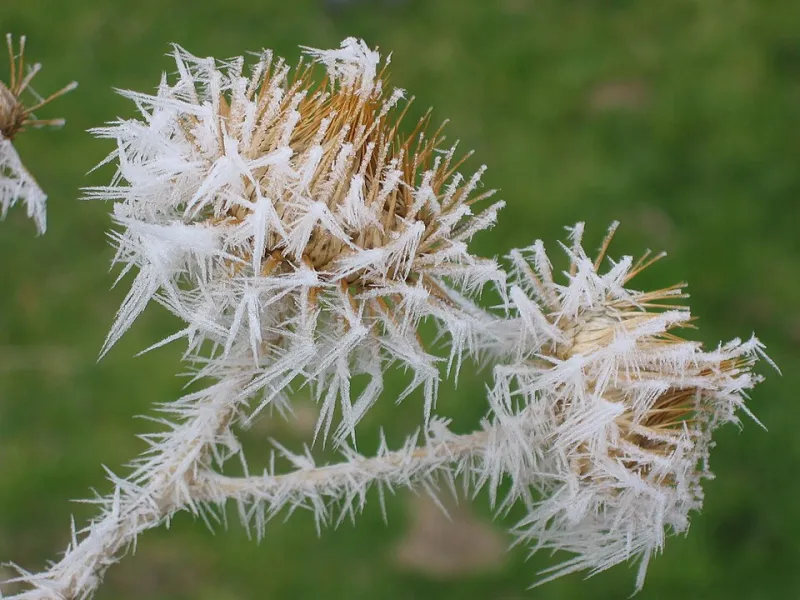
Photo: Nogwater from Oak Park, CA, USA, CC BY-SA 2.0, via Wikimedia Commons
November has a reputation problem. By the time the clocks have gone back and the last fireworks have fizzled, most photographers have mentally packed the camera away until spring. That is a mistake. The first proper frost is one of the best free shows in the UK, and an Olympus macro setup is almost purpose-built for it.
The trick is to treat a frosty morning like a small expedition. You are not chasing landscapes or wildlife; you are kneeling beside a seed head, a fence post or a fallen leaf, trying to catch ice before the sun takes it away. That is field craft at its most literal, and it rewards a bit of planning.
Start before the sun wins
Frost is a short-lived subject. On a clear November morning you might get 20 to 40 useful minutes before the light gets hard and the crystals start to melt. Arrive early, ideally before sunrise, and work small. A local park, an allotment edge, a churchyard wall, a canal towpath or the less-trodden corner of a National Trust garden will all do. If you want a bigger day out, RHS Wisley in Surrey, Westonbirt in Gloucestershire, Sheffield Botanical Gardens and the Royal Botanic Garden Edinburgh are all worth checking for opening times and early access. Just remember that frosty ground is fragile: stay on paths, do not kneel in beds, and leave the pretty stuff where you found it.
Take a kneeling mat or a bin bag, a microfibre cloth, a small reflector and a thermos. A torch is useful for finding subjects before the light comes up. Most importantly, take more than one battery.
Settings that leave room to work
The M.Zuiko 60mm f/2.8 Macro is the obvious starting point. It is sharp, small and gives you enough working distance to avoid bumping the subject with the lens hood. A 30mm macro can work for wider environmental close-ups, but the 60mm is easier for skittish frost detail.
Start around f/5.6 to f/8. Wide open, depth of field at macro distances is razor-thin; stopped down too far, diffraction softens the very detail you are chasing. ISO 200 is a sensible base. With flash, a shutter speed of 1/160sec to 1/250sec will kill most ambient blur and let the flash do the freezing. Use manual focus, turn on focus peaking, and brace yourself. If you are handholding, rest the lens on your wrist or a bag; if you are serious about a stack, use a low tripod.
Focus bracketing is where the Olympus bodies earn their keep. Set the step to 3 or 4, choose a count of 15 to 25 frames, and let the camera walk focus through the subject. For static frost on a leaf or a seed head, in-camera Focus Stacking is quick and satisfying, though it composites a limited number of frames. If you want more control, bracket a longer sequence and stack later in OM Workspace, Helicon Focus or Zerene Stacker. Keep the electronic shutter off when using flash; switch to mechanical shutter so the flash can sync.
Diffuse first, then chase the sparkle
Frost is basically a thousand tiny mirrors, which means direct flash is your enemy. It produces hard, ugly highlights and flattens the delicate structure of the crystals. Put something between the flash and the subject: a small softbox, a diffusion sock, or even a piece of translucent plastic held close. Add a white card or a tiny reflector on the opposite side to lift the shadows.
Aim for TTL flash at around minus 0.7 to minus 1.3 exposure compensation, or go manual at 1/8 to 1/16 power and adjust as you go. Check the histogram, not the back screen in bright light. Shoot raw so you can recover the cool highlights without losing the texture. A slightly cool white balance can suit frost, but do not overdo it; the best images still feel like a cold morning rather than a blue-filtered cliché.
Battery habits for numb fingers
Cold weather drains lithium batteries faster than you expect. Keep spares in an inside pocket, close to your body, and rotate them. Turn off Wi-Fi, dim the screen and let the camera sleep between shots. Do not leave the camera on a tripod for ages while you wander off. If you are moving between a warm car and cold air, give the gear time to acclimatise before you change lenses; condensation is a real risk in November.
A hand warmer in your pocket is not a luxury. Nor is a spare cloth for your viewfinder. Numb fingers drop things, and a dropped macro lens on a frozen path is a bad start to the day.
Five frost subjects worth kneeling for
Seed heads are the classic: teasels, hogweed, grasses and allium heads all hold ice beautifully. Spider webs are fragile but spectacular when backlit. Fallen leaves give you colour and texture in one frame. Fence wire, garden furniture and old metalwork can look like jewellery under frost. And feathers, when you find them ethically on a path or lawn, are superb subjects: the barbs catch ice and the structure rewards a focus stack.
The reader challenge: Frost Patterns
For our next Reader Challenge gallery, we want your frost-pattern macro frames. Send up to three images shot on any Olympus or OM System camera, with the lens, aperture, shutter speed, ISO and flash setup noted. Tell us where you found the subject, whether it was a garden, a park, a towpath or a window ledge. The deadline is 30 November 2026, and we will feature a selection in the magazine and online. The brief is simple: cold detail, warm craft. Get out before the sun wins.