The Patient Exposure: Live Composite for Britain's Winter Illuminations
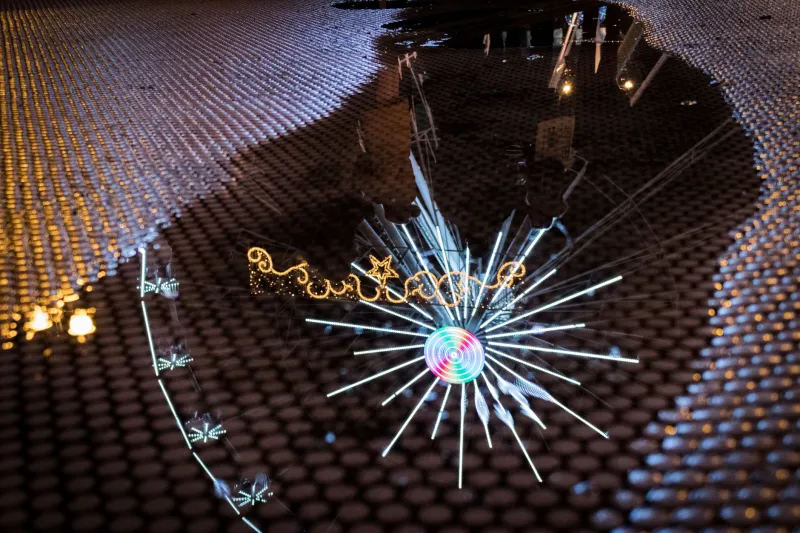
There is a point in early December when the UK stops pretending it is not dark. The high street switch-on has happened, the funfair has rolled into the market square, and every fountain in the country seems to have been fitted with a coloured uplighter. Wet pavements carry tail lights like spilled paint. This is the season Live Composite was quietly built for.
What the mode is actually doing
Live Composite is often filed under clever tricks, which undersells it. The camera takes a base exposure, then keeps taking more, but only records pixels that get brighter. Static parts of the scene stay put. Moving highlights accumulate. You watch the image build on the rear screen and stop when it looks right.
That is different from a conventional long exposure. You are not gambling the whole frame on one shutter opening. The static scene never gets brighter than your base exposure, so bulbs, lit fascias and illuminated stonework stay clean while the trails grow around them. For British winter light — small, bright, often LED, often surrounded by grey — that is close to ideal.
The baseline frame is the whole game
Everything depends on the first exposure. On most OM-D bodies, Live Composite has its own position on the mode dial; on models without that, look in the shooting menus. Set the camera to manual exposure, then choose a base shutter speed. For Christmas lights, one second is a sensible starting point. Half a second to two seconds covers most situations.
Aperture around f/5.6 to f/8 keeps point lights from bloating and gives you a little depth for market stalls and street furniture. ISO 200 is fine. Focus manually — autofocus hunts on fairy lights — and magnify to check the sharpest static detail in the frame.
Set white balance manually. Daylight or around 4000K is a good neutral choice. Auto white balance can drift between frames when LEDs change colour, and you want the mode to lock down its colour decisions, not improvise them.
Metering for a clean highlight
The base exposure controls the ambient scene, not the trails. If it is too bright, the picture looks like daytime with fairy lights glued on. Too dark and the trails become the only subject. Aim for a readable environment: building facades, wet ground, a recognisable skyline.
Use the histogram. Expose so the brightest static highlights — bulbs, shop signs, floodlit stone — sit just below the right edge. Do not rely on the screen outdoors; it will flatter a blown highlight. If the scene has bright LED strips and dark surroundings, meter for the strips and let the shadows fall where they may. Live Composite will not rescue a clipped base frame.
Tripod discipline in a British crowd
A tripod is non-negotiable. Spread the legs on wet pavement, use a weight bag if there is any breeze, and arrive before the switch-on rather than during it. Use a remote release or the two-second delay. Turn off stabilisation when the camera is on sticks, and keep a spare battery in an inside pocket — cold December air drains them faster than you expect.
Crowds are the real hazard. Set up low and wide, out of the main thoroughfare, and do not block a shop doorway or a bus stop. People will walk through your frame; that is part of the deal. A polite word and a moment's patience usually works better than guarding the tripod like a hunt saboteur.
Composition where the light will be
Frame for the trail, not for the bulb. Leave negative space where the moving light will travel. Anchor the image with something static: a lamp post, a statue, a market stall, the edge of a wet kerb. For fairground rides, ten to twenty seconds of building gives you a full arc. Fountains need only a few seconds before the water turns to milk. Traffic streaks want longer — twenty to forty seconds — but keep a landmark in the frame so the picture is about a place, not just speed.
Get low for wet-street reflections. Check the horizon. Use the level display. The temptation with Live Composite is to point at the brightest thing and watch the screen; the better pictures come from deciding what stays still and letting the light move through it.
Colour that stays believable
British winter light is not a Las Vegas advert. LED Christmas lights often run cool with a green cast; floodlit stone can go orange. Fix white balance at the base exposure and make small adjustments later in raw. Do not over-saturate the trails. The mood comes from the contrast between warm windows and blue evening air, not from pushing the saturation slider until the town centre looks radioactive.
Shoot during blue hour. In December that means starting around half past three, not half past five. A deep blue sky behind the lights gives context and stops the frame collapsing into black. By five o'clock the sky is gone, and you are relying entirely on wet reflections and illuminated buildings to carry the picture.
Four UK scenarios, starting settings
A high-street switch-on: one second, f/5.6, ISO 200, build for fifteen to thirty seconds. Catch the countdown and the first rush of light.
An illuminated fountain: half a second, f/8, build for two to four seconds. Any longer and the water loses its shape.
A fairground ride: one second, f/8, build for ten to twenty seconds. Time the arc rather than the whole ride.
Wet-street traffic: one second, f/5.6, build for twenty to forty seconds. Include a static landmark and watch for bus headlights blowing out the foreground.
When to leave it in the bag
If nothing in the frame is moving, Live Composite is just a tripod exposure with extra steps. If you want blurred people rather than light trails, a normal long exposure with a small aperture is simpler. And if the LEDs are flickering badly, test a longer base shutter before you commit — half a second or more often averages out the banding.
The mode rewards patience. Stand still, watch the screen, stop at the right moment. British winter is made of small glowing things against grey, and Live Composite lets you collect them without turning the picture into a fairground poster.